Practical Methods for Removing Tobacco Smell and Managing Indoor Air Quality
The moment you open the door, many people first "inspect the house with their nose": the curtains carry a stale tobacco smell, the sofa armrest releases odor when you lean on it, and in summer when the air conditioner turns on, the vents smell like an ashtray. Clothes hung overnight still smell like they just came from a smoking room. It's even more noticeable in the car — seat belts, headliner fabric, AC filter — any of these could be a "mobile smoke warehouse."
Tobacco smell is stubborn, not just because it's unpleasant. The particulate matter and various chemical compounds produced by tobacco combustion attach to dust, fabric fibers, wall paint films, pipes, and filters, and then slowly release into the air. In public health, this "deposit and re-release" exposure pathway is commonly referred to as thirdhand smoke issues: even when no one is currently smoking, the environment can still emit irritation and olfactory cues that make one "want to light up."
For people trying to quit smoking, the stale smoke smell at home and in the car is often a high-risk trigger; for families with children, elderly, those with rhinitis or asthma, reducing smoke and residue exposure is also the most basic air quality management. This article does not promote any brand of equipment, but provides a practical household manual: from principles to curtains, walls, air conditioning, clothing, car interiors, ventilation strategies, purifier use, and a daily/weekly checklist.
**Disclaimer:** This article is a household practical and health educational explanation, not a substitute for individual diagnosis, indoor air testing conclusions, renovation engineering, or legal guidance for chemical use. Cleaning agents should be used strictly according to product instructions; avoid mixing (especially chlorine bleach with ammonia-based cleaners). For acute asthma attacks, severe shortness of breath, chest pain, or altered consciousness, seek immediate medical attention. Environmental management cannot replace smoking cessation medical treatment and behavioral intervention.
---
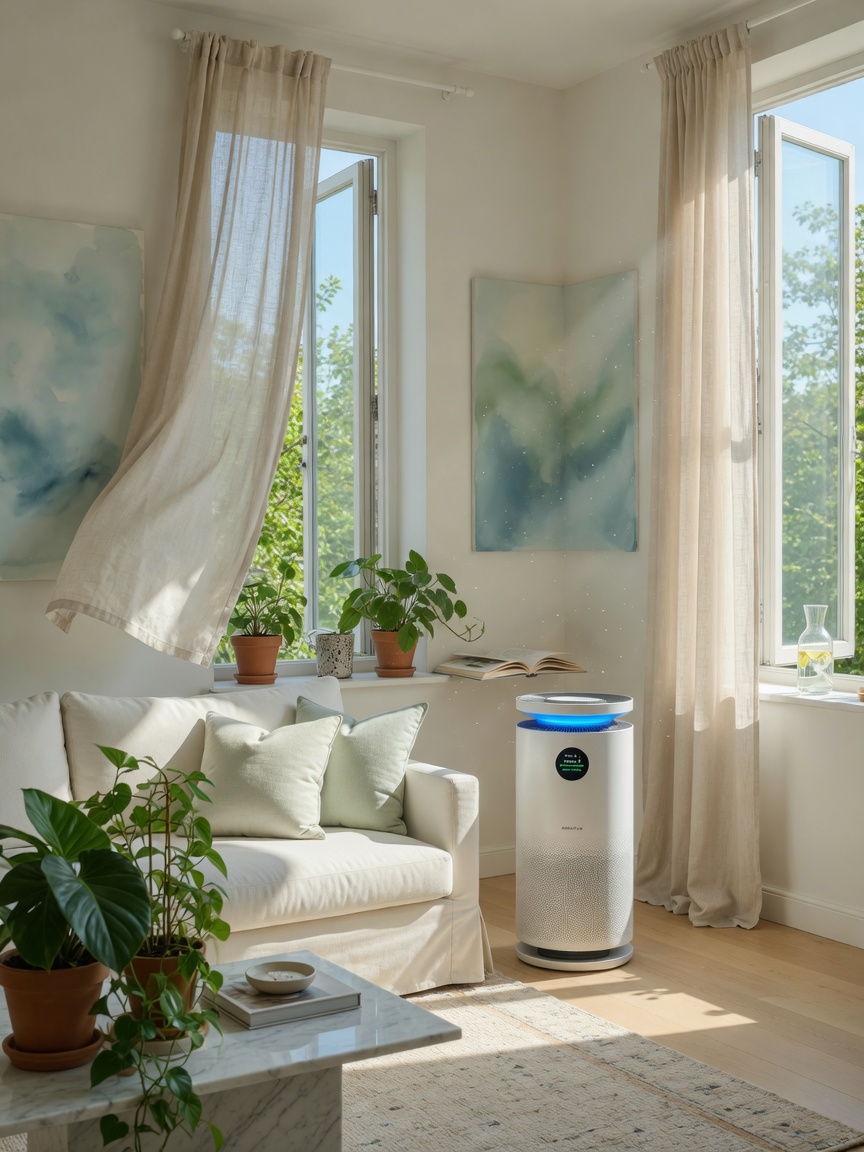
1. Understand the Basics: Why the Smoke Smell "Keeps Coming Back After Cleaning"
1.1 Smoke Smell Consists of Two Parts
| Type | What It Is | Common Attachment Sites | Removal Approach |
|---|---|---|---|
| Particulate matter & soot | Fine particles from combustion, tar-like deposits | Filters, vents, window tracks, top of lampshades, corners | Vacuum, wipe, replace filter media |
| Gaseous & semi-volatile compounds | Odor molecules, components that adsorb and re-release | Curtains, carpets, sofas, clothing, car headliner, wall paint micropores | Wash, ventilate, activated carbon adsorption, surface refinishing if needed |
Simply spraying air freshener is like covering old odor with a new layer of fragrance; the odor becomes more complex, but the source remains.
1.2 Dust is a "Secondary Pollution Source"
Smoke components love to stick to dust. The floor may look clean, but curtain folds, AC return vents, keyboard crevices, and under the sofa can still harbor "scented dust." When people walk or turn on a fan, the dust is stirred up, and the nose picks up the smoke smell again.
Therefore, the effective order is always:
- **Source control**: Stop smoking indoors (including bathrooms, enclosed balconies, and cars);
- **Remove carriers**: Wash fabrics, wipe hard surfaces, vacuum, clean filters;
- **Ongoing management**: Ventilation + filtration + humidity and cleaning routine.
1.3 The Three Pillars of Deodorization (Prioritize in This Order)
Stop indoor smoking → Deep clean adsorbent materials → Ventilate → Purify/adsorb equipment → (Finally consider) MaskingFragrances, essential
oils, and solid air fresheners belong to the masking layer — they can improve subjective perception after cleaning, but cannot replace cleaning itself. For people sensitive to smells or in the process of quitting, strong fragrances themselves can become new irritants.
---
2. General Principles and Safety Basics
- **Physical first, chemical second**
Vacuuming, water washing, and wiping with neutral cleaners are generally safer and more fundamental than immediately using strong chemical agents.
- **Do not mix cleaning agents**
Mixing chlorine bleach with ammonia-based cleaners can produce harmful gases. When switching between different products in the same area, rinse thoroughly with water and ensure adequate ventilation first.
- **Protect vulnerable family members**
When there are infants, pregnant women, pets, or asthma patients at home: open windows during cleaning; keep people away from heavily treated areas; wipe floors and low surfaces with clean water again; store chemicals in locked places.
- **Accept an "intensive week + maintenance period"**
A home that has been smoked in for years cannot be completely cleared in one weekend. A more realistic goal: significant improvement in the first week, stabilization within a month so that "you no longer get hit by the smell when entering," then maintain through habit.
- **Additional benefits for smoking cessation households**
Reducing environmental smoke cues helps lower the "smell it, crave it" conditioned reflex. Environmental management is part of smoking cessation support, not a criticism.
---
3. Practical Scenarios
Scenario A: Curtains and Fabric Drapes
Curtains are "sponges" for smoke smell. Thick blackout curtains, velvet, and heavily pleated styles have stronger adsorption.
Recommended steps:
- **Shake off dust outside first** (choose a windless or downwind direction to avoid blowing dust back indoors); or use a vacuum with HEPA filter on the folds.
- **Sort by care label**: Machine wash or hand wash removable items; add appropriate detergent, and use stain/odor removing laundry additives as instructed; rinse an extra time to reduce detergent residue smell.
- **Sunlight and air drying**: Sunlight and circulating air help with subjective deodorization (note: some fabrics may fade or degrade from prolonged sun exposure).
- **Non-washable items**: Thorough vacuuming → professional dry cleaning/curtain cleaning service → or steam cleaning (confirm the fabric's temperature tolerance).
- **Sheer and blackout curtains treated separately**: Wash sheers more frequently; thick curtains can follow a "deep clean once per season + biweekly vacuum."
| Situation | Action |
|---|---|
| Light smell, occasional smoking | Vacuum + ventilate 2–3 days + advance next wash |
| Heavy smell, years of accumulation | Must be washed or professionally cleaned; consider replacement if still heavy after washing |
| Allergy/asthma household | Prioritize machine-washable fabrics; reduce heavy velvet curtains |
Tip: On washing day, open windows and run the air purifier simultaneously to avoid "wet curtains drying indoors and reabsorbing old odors."
---
Scenario B: Walls, Ceilings, and Hard Surfaces
Smoke forms a light yellow oil film on walls and ceilings, especially near smoking areas, above light fixtures, and on door frame tops.
Daily actions:
- Remove surface dust with a vacuum or dry cloth first.
- Use a **neutral cleaner** or mild soapy water, wipe from top to bottom with a slightly damp cloth (to avoid dirty water streaks).
- Wipe again with a clean damp cloth to reduce cleaner residue.
- Include switch plates, door handles, window tracks, and baseboards — these areas transfer odor to the touch.
Notes:
- Cheap paint and wallpaper may not withstand scrubbing; test a small area first.
- Wallpaper, diatomaceous earth, and rough textured paint have strong adsorption; if they can't be wiped clean and the odor persists, partial renovation or professional assessment may be needed.
- **Heavily yellowed rooms due to long-term smoking**: If odor remains after cleaning, partial repainting with washable latex paint is often a more thorough solution (ensure no smoking during work, good ventilation, and follow renovation safety standards).
| Surface | Preferred Method | Upgrade Measure |
|---|---|---|
| Latex paint walls | Neutral cleaner, gentle wipe | Partial touch-up/repaint |
| Tile, glass, metal | Neutral or dedicated cleaner | Clean grout with brush |
| Wood furniture | Damp cloth + wood care | Avoid excess water; professional maintenance |
| Lampshades, ceiling fan blades | Remove for cleaning or stable high wipe | Cut power first |
---
Scenario C: Air Conditioners (Wall-mounted, Floor-standing; Car AC covered later)
The AC filter and heat exchanger fins are "collectors" for smoke particles. If left uncleaned for a long time, turning on the AC becomes a "smoke broadcast."
Wall-mounted/Floor-standing home routine (regular self-maintenance):
- **Cut power**, open the panel, and remove the filter.
- Rinse the filter with water; for heavy grease/smoke, gently scrub with neutral detergent, rinse thoroughly, and **dry completely** before reinstalling (damp filters are prone to mold, and musty odor will compound the smoke smell).
- Wipe the vents and louver blades with a damp cloth; visible mold should be treated per the manual or by a professional cleaner.
- After cleaning, open windows first, then run the AC in ventilation/fan mode briefly and check the odor.
- **High usage or past indoor smoking**: Check filters every 2–4 weeks; at least deep clean between seasons.
When to call a professional:
- The output still has obvious tar or musty smell, suspected evaporator coil contamination;
- Central AC, ducted system, or whole-house air handling;
- Water leaks, unusual noises, or electrical issues.
Principle: Clean first, then rely on running the unit to "blow out the smell." The longer you run a dirty filter, the more dust circulation and odor cycling you'll get.
---
Scenario D: Clothing, Bedding, Sofas, and Carpets
1. Clothing and Outerwear
- Outerwear worn in smoking environments: **store separately**, don't mix with clean clothes in the same closet.
- Washable items: normal wash + thorough drying; heavy outerwear can be washed a second time.
- Down jackets, wool coats, etc.: follow care label; if heavy odor persists, send for dry cleaning and mention "smoke smell."
- Use dehumidifiers in closets to prevent "smoke + musty" odor mixture; activated charcoal packets can help absorb odors — replace regularly per product instructions.
2. Bedding
Sheets, duvet covers, and pillowcases are in face-level contact all night. During a smoking cessation or deodorization intensive week: wash everything at the highest safe temperature for the fabric (follow care labels); change pillowcase covers frequently. Vacuum the mattress surface and use a mattress protector as a barrier.
3. Sofas and Throw Pillows
| Type | Method |
|---|---|
| Removable covers | Remove and wash + vacuum base (focus on crevices) |
| Non-removable | Vacuum + spot test fabric cleaner + thorough drying and ventilation |
| Leather/tech fabric | Specialized care; use soft brush + vacuum for crevice dust |
| Throw pillows/cushions | Prioritize washing covers; consider replacement if filling is heavily odorous |
4. Carpets and Rugs
Carpets are a heavy-hit area. Door mats can be washed weekly; large carpets: vacuum (slow, multiple passes) → carpet machine or professional cleaning → thorough drying (prevent mold). For carpets that are extremely smelly with deep, old fibers, replacement is often more practical than repeated masking.
---
Scenario E: Car Interiors
The car interior is small and enclosed, making smoke smell subjectively stronger; fabric headliners, seat foam, and seat belt fibers are very absorbent.
Recommended process:
- **Empty**: Remove all ash, cigarette butts, empty packs, and paper scraps (including storage compartments and cup holder crevices).
- **Vacuum**: Seat crevices, tracks, floor mat underside, trunk; take out floor mats, tap off dust, and wash.
- **Surface wipe**: Clean dashboard, steering wheel, door panels with appropriate interior cleaner; clean screens using proper screen methods.
- **Fabric seats/headliner**: Use specialized cleaner or professional steam/sauna cleaning; headliner is prone to water stains — go gentle rather than soaking.
- **AC system**: Replace or confirm the AC filter (scented filters cannot replace dirty ones); use legitimate AC duct cleaning products or professional service — avoid DIY liquid methods that could damage the system.
- **Ventilation**: After cleaning, open all doors for cross-ventilation; temporarily place activated charcoal packets under seats (do not interfere with pedals or airbag zones).
Mistake corrections:
- "A day of baking in the sun is enough": High heat may cause some odor molecules to become more active and release, briefly making the smell "stronger," and it's not friendly to interior aging; sun exposure cannot replace cleaning.
- "Air freshener = done": It only masks, and some people feel dizzy from it.
- "I'll keep smoking in the car since I have a car freshener": Smoking in the car causes extremely high exposure for occupants, especially children.
Driving habit: After someone smokes, open windows for ventilation as soon as possible; ideally establish a completely smoke-free car policy — more effective than any cleaning agent.
---
4. Ventilation Strategy: When to Open Windows and How to Do It Effectively
4.1 Cross-Ventilation is Better Than "Cracking a Window"
Try to create a draft: open opposite windows simultaneously; or one window for intake and another for exhaust. Each intensive air exchange of 10–20 minutes is often more effective than leaving a small gap open all day with no airflow (adjust based on outdoor weather and safety).
4.2 Recommended Order: "Exhaust First, Then Purify"
After cooking, after someone has smoked indoors, or after using strong cleaning agents:
- Open windows to expel the high-concentration air mass;
- Close windows and use the purifier to handle residual particles (if outdoor pollution is severe, shorten window opening time and increase filtration — see below).
4.3 Adjust Based on Outdoor Conditions
| Outdoor Condition | Strategy |
|---|---|
| Good air quality, no strong wind/dust | Active cross-ventilation |
| Smog, dust storms, high pollen | Shorten window opening; rely on purifier; ventilate briefly during low-pollution periods |
| Neighbor's BBQ/smoke drifting in | Close windows temporarily, run purifier; ventilate briefly afterward |
| Rainy/extremely humid | Ventilate + dehumidify to prevent mold odor compounding |
4.4 Seasonal Considerations
- **Winter heating**: Large indoor-outdoor temperature difference; use "short strong ventilation + reheat" approach to avoid prolonged sealing that concentrates smoke residue.
- **Summer AC rooms**: Open windows periodically for air exchange; don't rely solely on recirculation for days on end.
- **Kitchen**: Actually turn on the range hood; when cooking fumes and smoke odor combine, exhaust first then purify.
4.5 Ventilation Etiquette for Smoking Cessation
If someone in the household still smokes: agree on a fixed outdoor smoking spot, upon returning, use a transition area (e.g., balcony, entryway) to reduce bringing smoke smell into bedrooms; never smoke in children's rooms or bedrooms.
---
5. Air Purifiers and Auxiliary Equipment: Knowing How to Use is More Important Than Knowing Which to Buy
5.1 What Purifiers Can and Cannot Do
| Capability | Description |
|---|---|
| Good at | Reducing indoor particulate matter (including some smoke-related particles) |
| Conditionally good at | Helping with some odor molecules when equipped with sufficient activated carbon and other adsorbent materials |
| Not good at | Replacing washing curtains and sofas; eliminating all residues deep in wall paint; treating diseases |
| Misuse | Never changing the filter; placing it in a corner blocked by a sofa; expecting it to make indoor smoking harmless |
Key point: Running a purifier while continuing to smoke indoors cannot reduce exposure to "equal to a smoke-free environment." A smoke-free rule is still the top priority.
5.2 Three Easy-to-Understand Specs When Choosing
- **CADR (Clean Air Delivery Rate)**: Match the value to the room size; too small means the unit will struggle.
- **Recommended room size**: Follow the manufacturer's rating and leave some margin; be more conservative with high ceilings or open kitchens.
- **Filter construction**:
- Pre-filter: Catches large particles and hair;
- HEPA type: Fine particles;
- Activated carbon etc.: Assists with odors and some gaseous compounds (saturates over time — needs replacement).
5.3 Placement and Use
- Keep intake and exhaust away from walls; try to create airflow in frequently occupied areas.
- During intensive deodorization weeks, run the unit at a higher setting for a period after cleaning in the living room/bedroom.
- Listen for the unit's sound, check the filter life indicator, sniff the output for filter odor — replace when due.
- Coordinate with ventilation: when outdoor air is good, ventilate first then purify; when outdoor air is poor, reduce window opening and rely on the purifier.
5.4 Humidity Management (Often Overlooked)
Maintain relative humidity in the comfortable range of 40%–60% (use a simple hygrometer), which helps:
- Reduce mucosal dryness and discomfort;
- Prevent excessive humidity that promotes mold and dust mites (excess humidity worsens allergies and musty odor, compounding the smoke smell).
Clean humidifiers regularly to avoid "humidifying = adding mold."
5.5 Practices to Approach with Caution
- **Prolonged high-concentration ozone** in occupied spaces poses health risks and may damage materials; do not use as a daily "smoke removal wonder tool."
- Cheap aromatherapy and heavy alcohol-based sprays: they mask, can irritate, and have safety risks.
- Relying solely on coffee grounds or orange peels: at best, very mild masking or placebo; cannot replace cleaning.
---
6. Home Air Quality Management Schedule (Checklist)
Daily (5–15 minutes)
- [ ] Enforce a complete indoor smoke-free policy
- [ ] Cross-ventilate for at least 1–2 brief periods (adjust per outdoor air quality)
- [ ] Actually turn on the kitchen range hood when cooking
- [ ] Ashes and butts (if brought in from outdoor smoking) not left open in indoor trash bins
- [ ] For those quitting: reduce time spent in the "heaviest smoke-smell corners" (until cleaning is complete)
- [ ] Vacuum: floors, sofa crevices, window tracks, under bed edges
- [ ] Wipe hard surfaces: tables, chairs, door handles, switches, top of baseboards
- [ ] Check AC filter for visible gray/black buildup; clean if needed
- [ ] Replace or air out cushion covers; clean entry mats
- [ ] Empty car trash; enforce car smoke-free rule; briefly open windows if needed
- [ ] Wipe purifier exterior; confirm operation and filter status
- [ ] Vacuum curtains or wash per schedule
- [ ] Deep change of bedding; pillow maintenance
- [ ] Deep AC cleaning or schedule professional cleaning
- [ ] Check closets and storage areas for moisture and odor
- [ ] Car AC filter status; deep interior vacuum
- [ ] Inspect corners and top of light fixtures for smoke oil/dust buildup
Weekly
Monthly/Seasonal
"Intensive 7 Days" for Quitting or Moving In
| Day | Focus |
|---|---|
| Day 1 | Clear ash and open waste sources; whole-house vacuum; open windows; wash all pillowcases and sheets |
| Day 2 | Remove/wash curtains or send for cleaning; deep sofa vacuum |
| Day 3 | AC filters; vents; purifier in place |
| Day 4 | Sort clothes: heavy smoke-smelling outerwear washed separately/dry cleaned |
| Day 5 | Wipe key wall/hard surface areas; lampshades |
| Day 6 | Full car cleaning or detail shop; establish smoke-free car rule |
| Day 7 | Check odor problem spots; establish weekly checklist; reconfirm household smoke-free agreement |
---
Spray air freshener (masking)
Only covers odor; pollution source remains. Complex mixed smell may be more irritating.
Deep cleaning + ventilation + filtration (root cause)
Remove pollution carriers, reduce residue concentration, truly improve air quality.
7. Common Myths and Correct Alternatives
| Myth | Why It Doesn't Work | Correct Alternative |
|---|---|---|
| Spray air freshener = removing smoke smell | It masks; source remains | Clean fabrics + ventilate + filter |
| Only wipe tables, not curtains | Largest adsorbent untouched | Prioritize curtains/fabrics |
| Never clean AC filters | Unit recirculates pollution | Regular filter cleaning; professional clean when needed |
| Car air freshener is enough | Irritating + masking | No smoking + vacuum + replace cabin filter |
| Purifier running means no need to ventilate | Gaseous compounds and fresh air lacking | Brief strong ventilation when outdoor is good |
| Vinegar/coffee grounds are a cure-all | Limited evidence and effect | Can be supplementary, not a replacement for washing |
| Stronger chemicals are better | Irritation and mixing risks | Neutral cleaning first; safe use |
| One wash lasts ten years | Dust keeps settling | Intensive week + weekly maintenance |
| "Just one cigarette" indoors is fine | Exposure and residue still accumulate | Fixed outdoor spot + wash hands and change clothes upon return |
| Ok to smoke indoors if kids aren't home | Residue and surface contaminants remain | Zero indoor smoking at all times |
---
8. Relationship with Health and Smoking Cessation (Restrained Explanation)
Reducing indoor tobacco smoke and residue helps lower eye, nose, and throat irritation, odor discomfort, and improves family members' subjective air quality perception. Families with rhinitis, asthma, chronic respiratory disease patients, and children should strictly enforce no smoking indoors or in the car.
For those quitting smoking:
- A clean environment reduces the "smell → craving" conditioned reflex;
- Organizing rooms, washing curtains, etc., can also provide a visible sense of self-control;
- However, environmental cleaning **cannot replace** smoking cessation methods themselves (behavioral programs, counseling, medication if needed — follow medical advice).
If a persistent irritating odor remains after cleaning and ventilation, investigate: mold, sewer issues, renovation odors, or smoke from neighbors; consider air quality testing or professional housekeeping/maintenance intervention if needed. For persistent physical symptoms, seek medical attention — don't attribute all rhinitis symptoms to "still being able to smell a little smoke."
---
9. Red Flags and When to Seek Help
| Situation | Recommendation |
|---|---|
| Asthma attack, severe wheezing, difficulty speaking | Follow emergency plan and seek immediate medical care |
| Severe coughing, chest tightness, chemical exposure after using cleaners | Leave the area immediately for fresh air; seek medical attention/toxicology help if severe |
| Child accidentally touches cleaning agents | Follow product instructions and local emergency guidance |
| Suspected severe central AC contamination, leaks, mold | Stop using the affected outlet and contact professional maintenance |
| Severe withdrawal or depression/anxiety after quitting smoking | Contact smoking cessation clinic or mental health professional resources |
---
10. Summary: What to Remember on One Page
- **No smoking indoors or in the car** is the prerequisite for all deodorization.
- **Curtains, sofas, bedding, AC filters, and car fabrics** are the five heavy-hit areas — prioritize cleaning and vacuuming.
- **Hard wall surfaces** need oil film removal; consider partial refinishing for heavy yellowing.
- **Ventilation** relies on cross-flow and timing; **purifiers** handle particles and assist odor control — change filters regularly.
- **Fragrances are only supporting players**; chemical cleaners should not be mixed and require ventilation.
- **One intensive week + weekly maintenance** is far more reliable than dreaming of "one spray that keeps everything fresh forever."
Getting smoke smell out of the home is essentially about reducing the "absorbable dirt" and increasing the "flowing fresh air." It's not mysterious — just requires breaking it down by scenario and sticking to a calendar. When you open the door one day and your nose first encounters clean fabric and a gentle breeze instead of years-old smoke — that's not just a housekeeping victory; it's giving yourself and your family's respiratory system the space to truly rest.
---
Reference Directions (Further Reading Types, Not a Citation List)
- Public health educational materials on comprehensive indoor smoking bans and secondhand/thirdhand smoke
- Product manuals and electrical safety guides for home AC cleaning and filter maintenance
- General explanations of air purifier CADR, filter types, and recommended room sizes
- Household hygiene advice on indoor humidity and mold prevention
- Guidance on visiting smoking cessation clinics, respiratory/ENT departments for persistent respiratory symptoms
---
This article is practical educational content for home environment and air management, intended for foundational understanding and self-management reference. Follow product instructions for specific usage; consult professional medical personnel for health issues.
* Thirdhand smoke: tobacco residue that adheres to surfaces and dust after combustion, which can be re-released during cleaning, touch, or air disturbance.